Crypto in 2026, Why a Long-Only Bullish Plan Beats Timing the Top
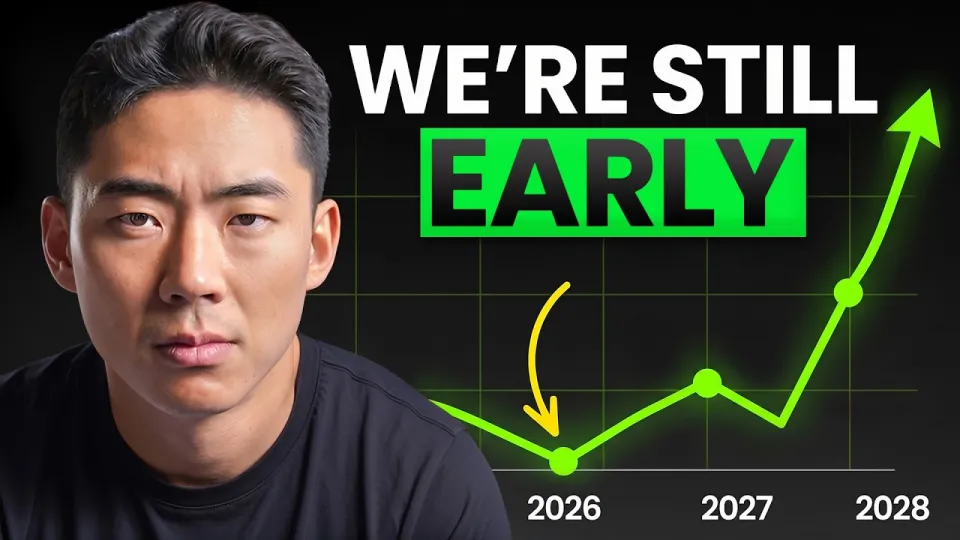
Video: my plan to make millions in crypto 2027
Want articles like this for your own video to promote it on YouTube and Google? Order them through the Telegram bot @sat_sit_bot. Articles with your video embedded are written and posted by the bot itself — on popular topical sites (no ads). Try it free: 50 articles on us.
Key takeaways
- Brian Jung's video "my plan to make millions in crypto 2027" splits the thesis into three blocks: why he is bullish, which narratives drive the next cycle, and how he allocates capital.
- The core bet is that crypto keeps absorbing capital as an asset class, not that any single coin goes up forever.
- Narratives named in the outline include Bitcoin, Ethereum, altcoins and specific ecosystems such as SUI, which viewers flagged in the comments.
- A plan needs a sizing rule and an exit rule written down before the cycle, otherwise conviction turns into holding through a drawdown.
- Stablecoin regulation and bank involvement (the Clarity debate) are treated as a structural tailwind by some viewers and a risk by others.
Crypto is best approached in 2026 not as a bet on a single coin but as a portfolio decision: pick the assets you can hold through a 50% drawdown, size them so a bad year does not end you, and let the cycle do the work. That is the practical answer to whether a bullish crypto plan works — it works only if the plan survives the scenario where it does not. Brian Jung's breakdown, published as "my plan to make millions in crypto 2027," is a useful template for structuring that decision, and his paid research tier is available through the Kaizen Pro waitlist.
Why the bullish case for crypto rests on flows, not predictions
The bullish argument is about capital formation, not price targets; crypto competes for allocation against gold, equities and cash, and every new regulated wrapper widens the funnel. Bitcoin spot ETFs in the US turned a niche asset into something a pension consultant can put in a memo, and Ethereum followed the same path. Once an asset has an approved access route, the decision stops being "should we touch this" and becomes "what weight do we give it."
That framing matters because it changes what you watch. Instead of asking where Bitcoin tops, you track:
- Net inflows into spot Bitcoin and Ethereum products.
- Stablecoin supply growth, which is the dry powder of the market.
- Regulatory direction — clarity tends to be bullish for institutional allocators even when it is bearish for the ideology.
- Developer activity in the ecosystems you hold, because narratives without usage decay fast.
One recurring objection, visible in the comments under the video, is that regulatory clarity is bad for crypto because it hands control to banks. That is a legitimate philosophical position, but it is not a price argument: bank custody and tokenized deposits have historically expanded the total addressable market before they compressed margins for incumbents.
The narratives that carry the next cycle
Narratives are where capital rotates after Bitcoin has done its job; the cycle pattern is Bitcoin first, Ethereum second, then sectors with a story and a catalyst. The ones worth tracking in this cycle cluster into a handful of buckets.
- Bitcoin as an institutional asset. ETF flows, corporate treasury adoption and halving-driven supply scarcity keep BTC the default entry point for new money.
- Ethereum and the L2 economy. Staking yield, restaking and rollup economics make ETH a cash-flow argument rather than a pure narrative.
- High-throughput L1s. SUI is the example viewers keep asking about; fast execution and a consumer-app focus give it a distinct pitch, but the token unlock schedule is the thing to model.
- Real-yield and tokenized assets. Anything that pays from actual revenue rather than emissions gets a longer leash from allocators.
- Consumer and payments rails. Stablecoin settlement and on-chain brokerage features, including the crypto products Robinhood has rolled out, pull in users who never touch a self-custody wallet.
A narrative is only investable when you can name the catalyst, the timeline and the thing that would prove you wrong. If you cannot fill those three blanks for a coin, it belongs in a watchlist, not a portfolio.
How to build a crypto plan that can actually make money
A plan to make millions is really a plan to survive volatility; position sizing and rules do more for returns than asset selection. The sequence below is the one that holds up across cycles.
- Write the target in percentages, not dollars. "Beat BTC by 20 points over the cycle" is testable; "turn $5k into $500k" is a lottery ticket.
- Split the book into a core and a satellite. A core of BTC and ETH sized so a 70% drawdown is annoying but survivable, and a satellite of higher-beta names capped at a fixed share of the total.
- Cap any single altcoin. A common rule is 2–5% of the portfolio per name; anything above that turns a thesis into a single point of failure.
- Set the exit before the entry. Decide what you sell at 2x, 5x and 10x, and what invalidates the thesis entirely — a broken roadmap, a token unlock cliff, a team exit.
- Keep a cash and stablecoin buffer. Dry powder is what lets you buy the drawdown instead of watching it.
- Rebalance on a calendar, not on emotion. Monthly or quarterly, trim what ran and top up what lagged, so the portfolio does not silently become one bet.
Viewers who say they will put half the portfolio into altcoins are describing step two and skipping steps three and four — which is exactly the configuration that produced the "I lost everything" comments after the last cycle.
Risk rules that separate a plan from a prayer
Risk management is the only part of a crypto plan that is fully under your control, so it deserves more time than coin picking. Four rules cover most of the damage.
- Define the maximum drawdown you will accept in advance. If a 60% portfolio drop would force you to sell, your allocation is too aggressive regardless of how bullish you feel.
- Separate conviction from position size. You can be extremely bullish on a network and still hold it at 3% of the book.
- Track unlocks and emissions. Supply schedules are public; most altcoin drawdowns start on a calendar date, not on a news headline.
- Use custody you understand. Self-custody removes counterparty risk but adds operational risk; exchange custody reverses that trade-off. Pick deliberately, not by default.
On timing, the honest answer is that nobody knows where the top lands — commenters argue for 2027, for 2029, and for "it could go up or it could go down." A plan that requires a specific top date to work is not a plan.
Common questions crypto investors keep asking
The most frequent doubts are not about which coin to buy but about how to behave when the market disagrees with you. Three patterns repeat.
First, the "always bullish" critique. Anyone publishing a cycle thesis sounds permanently optimistic, because the content that gets made is the content with a directional view. The corrective is to read the risk section of any thesis as carefully as the upside section — including the disclaimers that the video itself carries, which state plainly that the material is educational and not financial advice.
Second, the fear of repeating a bad cycle. Losing money in a previous cycle is usually a sizing and exit problem, not a selection problem; the same coins bought at 3% weights with pre-set trims produce a very different outcome.
Third, the question of whether to wait for a crash. Waiting is a position, and it has a cost: if the market does not cooperate, you hold cash through the expansion and buy the euphoria instead. Scaling in on a schedule removes that binary choice.
Useful links
- Kaizen Pro waitlist — access page for the paid research product.
- Free crypto market report newsletter — weekly market notes.
- Brian Jung on X and Instagram.
- Risks and disclaimers document referenced in the video.
Final takeaway
A crypto plan for this cycle should be judged by how it behaves in the bad scenario, not by the size of the number in the title. Build a BTC and ETH core, cap altcoin exposure per name, write exits before entries, and keep a buffer for drawdowns. Brian Jung's breakdown is a reasonable starting framework — his outline moves from the macro bull case to narratives to allocation — but the allocation rules are the part you have to write yourself. If you want his research process in more detail, the Kaizen Pro waitlist is where that material lives. None of this is financial advice; crypto remains highly volatile and speculative.
Questions & answers
Is it realistic to plan for millions in crypto from a small account?
Only as an outcome of a process you control, not as a target you set. A realistic plan fixes position sizes, caps per altcoin and pre-set exit levels, then lets returns compound if the cycle cooperates. Plans built around a required multiple usually force oversized bets that fail in the first drawdown.
Should I put half my portfolio into altcoins?
A 50% altcoin allocation is aggressive but not irrational if you accept a 70–80% drawdown on that half and hold a BTC/ETH core alongside it. The bigger risk is concentration in one or two names, so cap each altcoin at a few percent of the total book.
Does regulatory clarity help or hurt crypto prices?
It usually helps institutional flows and hurts the ideological case, because clear rules bring banks and custodians into the market. Historically, expanded access has grown the total market before it squeezed margins for existing players, though it does centralize more of the stack.
When will this crypto cycle top?
Nobody knows, and estimates range from the near term to several years out. The practical approach is to define trims at fixed multiples and rebalance on a schedule, so the portfolio takes profit regardless of where the top lands.
Source: my plan to make millions in crypto 2027 · Markdown version